The Calculus of United Nations Infraconflict
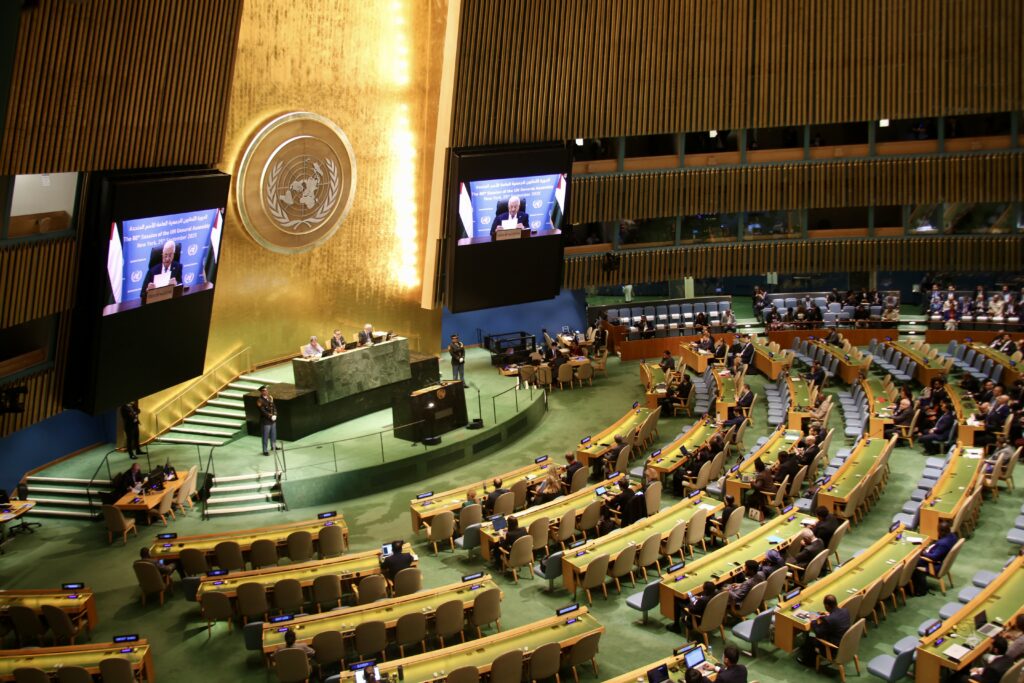
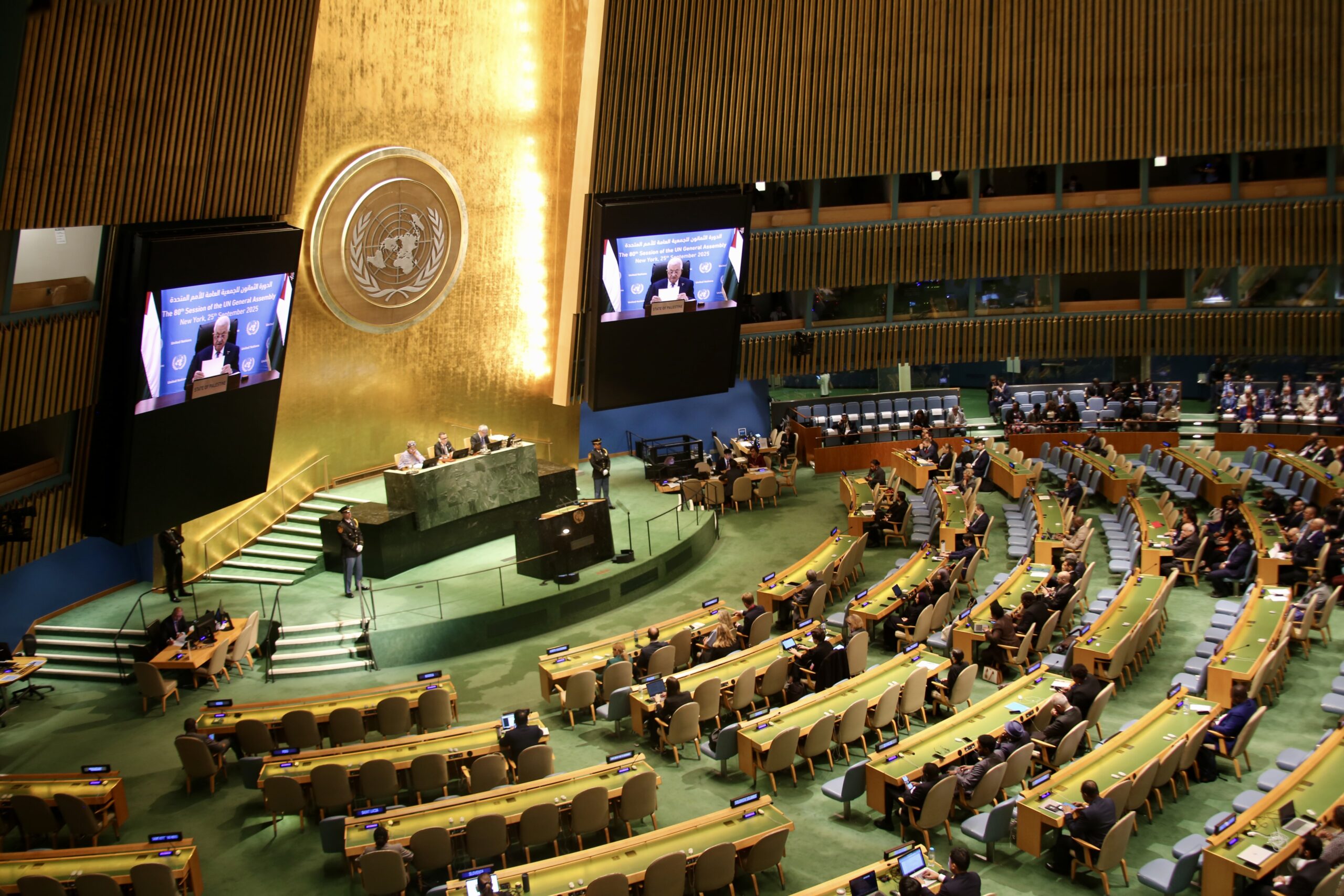
Photo: Palestine President Mahmoud Abbas Addresses UNGA 80 in a pre-recorded video. Niyi Fote/Thenews2
- At the outset of this year’s 2025 UNGA, and at the risk of irritating US leadership, a number of key NATO allies made news at the start gate by recognizing the State of Palestine. Leading the charge of a political light brigade were most notably France, the United Kingdom, Belgium, Luxembourg, Portugal and Canada, as the frontrunners. Of course, NATO members Spain, Norway, and Slovenia already had jumped the recogniton-gun in 2024, but no one even uttered a whisper at the time !
A notably absent outlier, Italy — but more on that later.
For France and the UK, pulling a fast one on Donald Trump by taking the limelight to recognize Palestine at the start of UNGA week, before Trump’s expected speech in the General Assembly was all a big risk — and one which the nation state perpetrators involved really didn’t consider, on a number of levels.
Ultimately, the fallout was triggered a reality TV comedy on the streets of Manhattan, as Macron’s motorcade was stopped in its tracks and French power was momentarily-rendered impotent. For the longer term however, the calculus of infraconflict at the UN has longer term implications, given the potential triggering Israeli annexation of Palestinian territories, while everyone else argues about recognition — notwithstanding the valid recollection that Palestine recognition timetables stretch back far into recent and remote history, with Brazil recognizing Palestine in 2010, and NATO member Turkey in 1988.
Of course, the diplomatic and historical meaning of recognizing the governing thesymbolic governing Palestinian Authority — which doesn’t even control Palestine in a cogent sense, provides legitimacy to the political rank and file mass of Palestinians who privately or publicly side with either Hamas, Hezbollah, or the Islamic Brotherhood, as the perceived dominant standard bearers of Palestinian constituency.
Naturally, the definiton of a political constituency has never sociopolitically-applied to any attempted definition of a political, governing Palestinian leadership nidus. One reason for this is that political power in Palestinian culture does not derive from a bottoms-up legitimacy of electoral support granted by a grass roots constituency. Rather, Palestine is a political culture dominated by clans, by layered generational family wealth, by external Islamic forces (Iran, Lebanon, Turkey, Qatar and others), as well as by various regional factors and nation-state associations.
Hence, political power and legitimacy among Palestinians is a top-down phenomenon, vested in families or other centers-of-power wielding various levels of hierarchial and acquired wealth, as well as geographical dominance, Hezbollah in the north, Hamas in the south and east — and the Islamic Brotherhood more diffusely infiltrative throughout Palestinian political culture, inclusive the occupied West Bank.
Then, there is the issue of who is being liberated and politically-recognized as constituting elements of a state, nominally-spoken for by a Palestinian Authority –which is at best a political shell not viewed as much more than that ,by a preponderance of Palestinians. Moreover, the elements of Palestinian political culture and ‘citizens-to-be-constituency’ slated for recognition incude a previous surrogacy (Lebanon), a refuge (Egypt), an occupation (West Bank and Golan), as well as a virtual ‘no man’s land’ (Gaza).
Ultimately, any reasonable observer without appreciable bias rapidly concludes that merging these hopelessly-disparate elements into a coherent, quasi-unified state with a central identity and government seems all but impossible. At that point, and absent a strong and unifying leader, ideology, or civil and military structure, the mirage of a recognized Palestinian State seems a virtual political placard at best, or absurdity at worst.
In essence, and in exchange for a moment in the political sun — just before the United States was expected to come crashing through the gates throwing real political weight around — a valiant, adventurous France, Britain and cohorts opened this year’s UNGA with a short-lived flash, designed to revive historical recollections of great power status.
In the maelstrom, two players were notably quiet — Italy and China. Why ?
China has nothing to gain from advertising its long-standing recognition of Palestine. To do so would not secure Mediterranean bases for the Chinese Navy, while China has far too massive a scale of infrastructure investments in Israel to place them at public relations risk. In contrast, although China strongly supports Iran, and while the advantage of promoting continued turbulence surrounding the Palestinian recognition issue would reinforce valuable and salient propaganda value for Iran, that still remains an insufficient inducement for China to demonstrably-rock the boat on this issue at the UN.
A significant consumer of Iranian Oil & Gas products, Italy is quite another matter. Italian Prime Minister Meloni has stood isolated, but cleverly positioned on the world stage, arguing that recognition of Palestine actually plays into the hands of the Israeli right wing — undeniably-guilty of inducing unprecedented starvation and morbidity in Gaza.
Meloni’s position has been that if land is recognized as a State by other nations, then that action can be short-circuited by annexing the territories in question as part of the State of Israel, thereby in the eyes of some permanently freezing the problem. In Meloni’s view, codification of Paletinian recognition by her European and NATO allies all but insures that Israel may pre-emptively annex Palestinian territories as part of an expanded post-modern Israeli state. Territory that is already an integral part of one state cannot be recognized as another self-standing state, Thus, recognition opens a highly risky and destabilizing door for annexation, and for the permanent emergence of a forced single-state solution.
That is Meloni’s powerful and compelling argument against recognition in the absence of a durable armistice, peace treaty and post-conflict state boundary resolution aimed at introducing a viable and lasting two-state solution. Rumblings from the Israeli right suggest precisely this course of action in the near future, thereby transforming Israel’s malfeasant actions in Gaza a matter of internal state security, rather than the criminal occupation of a foreign neighboring state entity.
Thus, the multinational United Nations environment has provided France, Britain and Canada with an opportunity to solve British General Allenby’s old problem, precisely in the manner that the historic WW I military leader would likely have least intended. Yet, this is what recognition under the fanfare of the UK and France seizing the limelight at 2025 UNGA has precisely set the international geopolitical engironment up for.
In essence them, many might argue that British and French competition for revisitng superpower status in advance of an American – Trump steamroller at the UN, is pure one-upmanship, attempting to pre-empt an inevitable loss of perceived power to the American UN host nation and monolith.
Which of course is exactly what the UK and France harvested for their efforts, Just a fortnight later, the result was apparent. A nearly helpless French President Emmanuel Macron was seen on live TV, rousing Donald Trump on the cell phone, as Macron was painted as helpless against the NYPD — who allowed his motorcade to become entrapped in the balmy night, mired in a Manhattan traffic trap while waiting for other motorcades to pass by.
How France has sunk — superpower status no more, the publicity from Palestinian recognition aside. The imager was pure New York media hype — the French President, no tricolor in site, briskly walking down endless Manhattan streets, crossing the island while walking at Parisian ambulatory speeds, and stopping for selfies with New Yorkers en route — Macron ultimately made it to the safety of the French Legation on the city’s posh FIfth Avenue Upper East Side, but at what cost to the French image as a trade-off to any advantage for having recognized Palestine.
This was not a French Victory — it was the symbolism of setback. Surely the Secret Service and NYPD could have insured that Macron’s motorcade was allowed to proceed without impediment. This was purposeful payback for Macron having mounted a play against US wishes at the outset of the UNGA — it was a night that wreaked of a Trumpian Reality TV revenge, executed on camera from behind the scenes, while the world watched the President of France taking a long walk.
At the UN, one major lesson should never be forgotten — it’s still New York, and the rules here are different than anywhere on the planet. During UNGA in the Big Apple, one plays games at the risk of triggering an undesirable calculus of counterparty risk. As Macron learned, the infraconflict environment during UNGA week in New York can resemble a nightime escapade on New York’s Upper East Side urban jungle that one is unlikely to forget for a long time to come.
More notable however are the potential long-term sequelae stemming from the European adventure in Palestinian recognition on the eve of 2025 UNGA — and that is the potential of recognition unexpectedly leading to annexation.
Some Calculus — Some Risk !
Dr Roger Hanwehr
Julia Mineeva
Co-Published:
© 2025
Thenews2 (New York, São Paulo)
EGBN News (Paris, New York, Berlin, Vienna)